
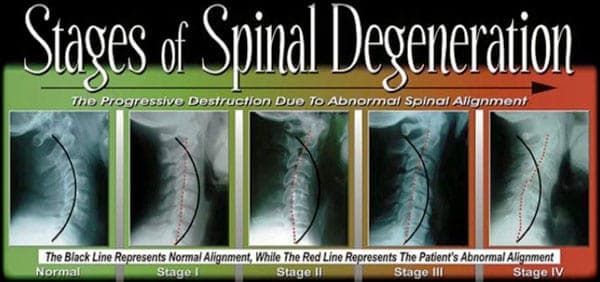
Last time we looked at some of the things that can put stress on your spine over the years. As promised, I want to walk you through the different stages, or phases, of spinal degeneration so you have a clearer picture of what can happen when those changes go unaddressed.
Phase 1: The Curve Starts To Change
When alignment and posture in the spine shift and that shift is left unaddressed, the spine can start to lose its normal posture over time. In the neck, a Phase 1 change often shows up as a straighter neck, or a neck where the normal forward curve has flattened or begun to reverse.
Here is a simple illustration of the different stages of spinal degeneration.
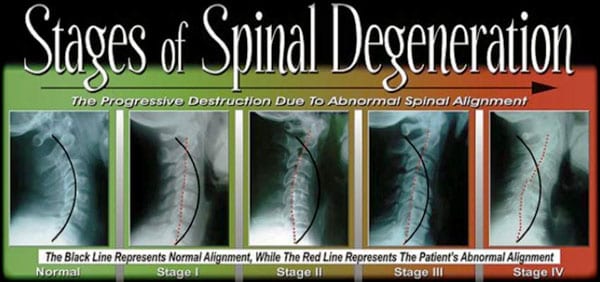
Phase 2: Disc Changes And Bone Spurs
If a Phase 1 change is not addressed, it can progress to Phase 2. At this stage we often see thinning of the spinal discs along with the formation of bone spurs on the vertebrae.
Phase 3 And Beyond: More Levels Involved
When Phase 2 changes continue without care, more levels of the spine can become involved, and in advanced cases the vertebrae may begin to fuse together. These later stages tend to come with more stiffness and reduced movement in the affected areas.
The reason I share these phases is not to alarm you. It is so you understand that posture and spinal health are things you can pay attention to early, when there is the most room to support healthy movement.
What Your Spinal Discs Do
Phase 2 involves the discs, so it helps to know what they are. A disc sits between each pair of vertebrae. It's made mostly of cartilage with a jelly-like centre, and it has 2 jobs: it keeps enough space between the vertebrae for the nerve roots to exit the spine, and it acts as a shock absorber.
People often tell me they've been told they have a slipped disc. Discs don't slip. Each one is firmly attached to the vertebra above and below it. What can happen is that a disc thins out, swells or bulges, or tears so the jelly-like centre pushes out (a herniation). Any of these can be involved in neck or low back pain, and sometimes in pain that travels into the arm or down the leg, often called sciatica.
Early Signs to Watch For
Spinal decay works a lot like tooth decay: it can be under way well before it hurts. A cavity often shows up on a dental x-ray before you feel it, and early spinal changes can show up on a spinal x-ray the same way. The difference is that a tooth can be replaced and your spine can't.
Before pain arrives, the early changes are often visible in your posture. Watch for shoulders that sit at different heights, hips that look uneven, or a hump forming at the top of the back. Stiffness and a gradual loss of flexibility tend to come next. These signs often trace back to an old fall, a car accident, a sports injury or another strain to the spine that was never looked at.
What a Check-Up and Care Plan Can Involve
To find out which phase your spine is in, if any, we need to look. I start with a computerized posture scan and take spinal x-rays if they're needed, then go over the results with you before recommending anything. A Phase 2 spine usually needs a more involved plan than a Phase 1 spine, since the changes have had longer to develop.
Care may include chiropractic adjustments, done by hand or with a small hand-held instrument called an Activator, spinal traction in the office to support your posture, and home exercises to strengthen the muscles that hold your spine in position. Progress checks, and comparison x-rays when they're useful, help us see how things are changing.
Why It Helps To Look Early
Many of these changes develop gradually and can be present before you notice much in the way of discomfort. Looking at how your neck and back are moving sooner rather than later gives us a better sense of what is going on and how chiropractic care may help support your posture, mobility, and day-to-day comfort.
Next time I will share some of the things you can do at home to look after your spine, for yourself and for your kids. In the meantime, if you have questions about any of this, I am happy to talk it through with you. Spinal and postural concerns can run in families, so family appointments are available.
Have a Question About Your Care?
Our team is happy to help. Reach out and we’ll get back to you.
Get in touch
